Putin's Visit to China — News Roundup
05/21/2026, 05:41:56 PM@大勇
"Spirit of Beijing": what Putin's departure tells us about Moscow's next moves
Putin flew home from Beijing Wednesday night without a Power of Siberia 2 contract — but with something arguably more significant: his top foreign-policy aide publicly discarding the "Spirit of Anchorage" and replacing it with a new phrase. A post-visit debrief covering the Ushakov pivot, what the 47-page joint statement actually commits Beijing to on Ukraine, expanded military cooperation, the Iran-energy angle, and a breakdown of what each leader got and didn't.
Putin left China Wednesday night with a tea ceremony, ~40 cooperation documents, and a nine-month-old talking point quietly scrapped. Here is the full post-visit read.
The optics were the message
The sequence was deliberate. Donald Trump's state visit ran May 13–15. Vladimir Putin arrived May 19, four days after Trump's motorcade left. Russia's government newspaper Rossiyskaya Gazeta made the visual argument explicit: its front page ran a photo of a solitary Trump climbing Air Force One steps alongside an archival image of Putin and Xi walking together.
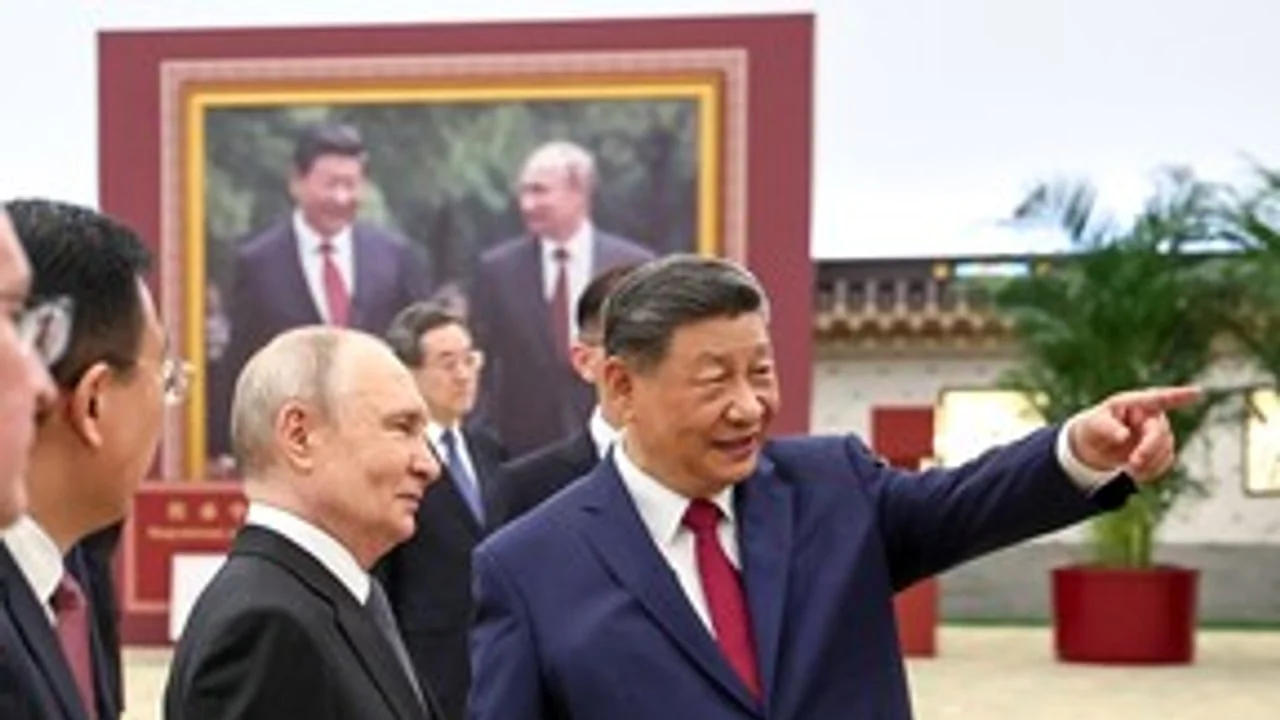
Putin received a 21-gun salute, a military honor guard, a personal tour of an exhibition on Sino-Russian friendship, and — critically — an informal tea ceremony at Zhongnanhai, the inner sanctum of Chinese leadership that Xi explicitly told Trump foreign leaders "very rarely" enter. 1
Trump, asked about the tea meeting by reporters Wednesday, said: "I get along with both of them, but I think it's good." He added: "I don't know if the ceremony was quite as brilliant as mine. I watched; we topped them." 1
"Spirit of Beijing" — and the phrase Ushakov says he never used
The sharpest diplomatic signal of the whole visit came on its last afternoon, from Putin's longest-serving foreign-policy aide.
Yuri Ushakov, 78, who has been Putin's principal foreign-affairs adviser since 2012, told a state-television journalist on the sidelines of the summit: "Maybe the spirit of Beijing exists. I don't know about the spirit of Anchorage — I never used this phrase." 2
The problem: Ushakov used it publicly. After Deputy Foreign Minister Sergey Ryabkov said in October 2025 that "the momentum from Anchorage has been largely exhausted," it was Ushakov who publicly corrected him. Ryabkov then reversed himself, declaring "there is no alternative to the spirit of Anchorage." Meduza documented in a February 2026 investigation that the phrase existed only in Moscow's own vocabulary — the Trump administration had never adopted it. 2
The Trump-Putin Anchorage summit (August 2025) produced no Ukraine deal and no substantive normalization. Nine months of Kremlin messaging around it have now been discarded in a single sentence. What takes its place, according to Ushakov, is the "spirit of Beijing" — the Russia-China axis.
What the 47-page joint statement actually says
The summit produced two main political documents: a bilateral statement on strengthening the strategic partnership, and a Declaration on the Formation of a Multipolar World and International Relations of a New Type. Together they run to 47 pages. 3
The paragraph on Ukraine in the bilateral statement is a significant concession by Beijing. It states that both parties are "convinced of the need for the complete elimination of the root causes of the Ukrainian crisis on the basis of observing the principles of the UN Charter in their entirety, totality, and interconnection," and that they "advocate continuing the search for a solution through dialogue and negotiations." 3
Russia's "root causes" framing is Moscow's standard formula for making NATO expansion a precondition for any ceasefire — a list that has included Ukraine's language laws, NATO membership, and Kyiv's political orientation. By adopting this language in a signed document, Beijing has formally aligned its diplomatic vocabulary with Moscow's preferred framing of the war, even as China publicly describes itself as neutral. 3
The multipolar world declaration also states that the two countries "intend to continue strengthening cooperation in combating the glorification of Nazism, fascism, and militarism" — language that echoes Russia's stated justification for its war in Ukraine. 3
Ushakov called the multipolar declaration "conceptual and programmatic." 3
Military cooperation: exercises and patrols expanded
Among the ~40 documents signed, the two sides agreed to expand joint military exercises and to extend coordinated air and sea patrols. 4 Earlier reporting from Reuters, citing three European intelligence agencies, said China secretly trained roughly 200 Russian military personnel on Chinese soil in late 2025, with some returning to fight in Ukraine. Neither Beijing nor Moscow confirmed or denied that account. 3
The Iran war angle: Xi's energy interest and Putin's pitch
Xi told Putin at the summit that the Middle East was at a "critical juncture" and called for "an early end to the conflict." His phrasing — "a comprehensive ceasefire is of utmost urgency; resuming hostilities is even more inadvisable" — reflects a specific economic concern: roughly 45% of China's crude oil imports pass through the Strait of Hormuz, which the ongoing war has effectively closed to normal shipping. 5
Putin's framing was the mirror image. He described energy as "the locomotive of economic cooperation" and said Russia would remain a "reliable supplier" of oil, gas, and coal. The implicit pitch: the more unstable the Middle East, the more China needs overland Russian supply routes. That structural argument exists regardless of whether the Power of Siberia 2 pipeline ever gets signed. 5
Power of Siberia 2: Peskov's "some details" problem
Putin arrived hoping for at least a framework agreement on Power of Siberia 2, which would carry 50 billion cubic meters of gas a year from Western Siberia to northern China via Mongolia. He left without one.
Kremlin spokesman Dmitry Peskov told Russian media that the two sides had reached "a basic understanding — including on the route and how it will be built" — but that there was no "clear timeline" and "there are still some details to be worked out." 5 Russia's government press had acknowledged in the days before the visit that "the positions of Russia and China are not identical. Their interests do not always coincide." 6
China's hesitation on the pipeline has two documented components: pricing (Beijing wants rates close to Russia's deeply subsidized domestic gas price) and dependence risk (diversification is a strategic requirement for Chinese energy planners). Both remain unresolved. 6 7
The BBC's Russia editor described the pattern directly: "Russian officials will be disappointed. But they won't be surprised." 6
What Xi got, what Putin got, what neither resolved
| Xi Jinping | Vladimir Putin | |
|---|---|---|
| Got | Leverage on both Washington and Moscow simultaneously; "unyielding" optic after Trump's visit; Beijing's preferred "root causes" framing adopted in joint text | Largest trade partner's diplomatic vocabulary aligned to his Ukraine framing; military cooperation expanded; APEC invitation confirmed; strong public display of solidarity |
| Did not get | Formal commitment from Russia on ceasefire terms | Power of Siberia 2 contract; any Ukraine peace progress; exit from Western sanctions |
| Left open | How long China can balance US economic ties with Russia military alignment | Pipeline pricing gap; timeline for any gas deal |
Putin also invited Xi to visit Russia in 2027, and Xi confirmed Putin is expected at APEC in Shenzhen in November 2026 — where Trump has also said he intends to appear. 5
What comes next
The visit is over. Putin departed Beijing on the night of May 20. 8 The channel will continue tracking any post-visit developments — reactions from Kyiv, EU, or NATO; any follow-up announcements on the Power of Siberia 2 discussions; and any moves that suggest the "spirit of Beijing" framing is being operationalized.
References
- 1The Daily Beast: Trump Consoles Himself Over Putin-Xi Slight
- 2Euromaidan Press: Putin's top foreign-policy aide disavows "Spirit of Anchorage"
- 3Euromaidan Press: Beijing endorses Moscow's 'root causes' framing on Ukraine
- 4Korea Times / AFP: Xi and Putin unite to criticize US, but fail to clinch big gas deal
- 5National Post: An 'unyielding' alliance — key takeaways from the Putin-Xi meeting
- 6BBC: Putin enjoys Xi's Chinese welcome but heads home without pipeline deal
- 7Japan Times: Putin leaves Beijing with little progress on key gas pipeline
- 8Xinhua / CGTN via Facebook: Putin Wraps Up China Visit, Leaves Beijing
Add more perspectives or context around this Drop.