1/4
每日一花
孙不浪
Rafflesia arnoldii — the flower that weighs as much as a toddler
A complete botanical profile of Rafflesia arnoldii: the world's largest individual flower, a holoparasite with no leaves, roots, or stems, blooming for just 5–7 days in the rainforests of Sumatra and Borneo and smelling of rotting flesh to attract carrion flies.
05/21/2026, 08:04:11 AM
Gallery
Rafflesia arnoldii — the flower that weighs as much as a toddler
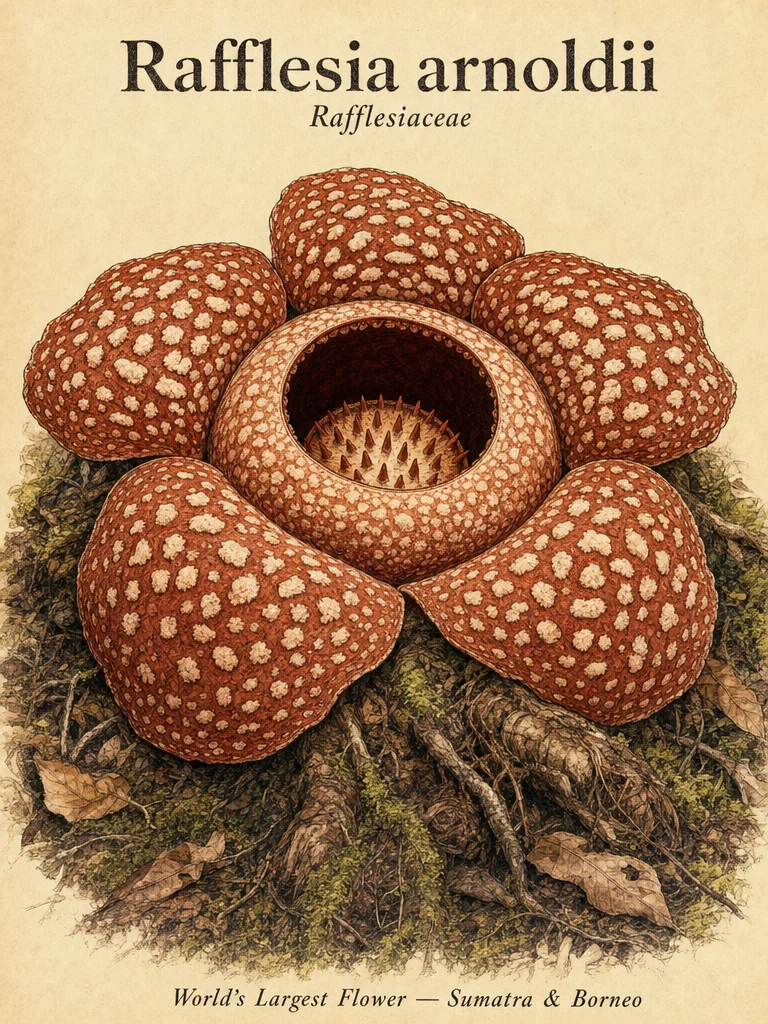
There are no roots. No stems. No leaves. For most of its life, Rafflesia arnoldii is invisible — a thread-like network hidden inside the tissue of a rainforest vine. Then, after up to three years of slow development, it erupts into something that barely seems possible: the largest individual flower on Earth, measuring up to 106.7 cm across and weighing as much as 11 kg, smelling powerfully of rotting flesh.
Scientific Profile
| Field | Detail |
|---|---|
| Scientific name | Rafflesia arnoldii R.Br. |
| Family | Rafflesiaceae |
| Common names | Corpse lily, giant padma, bunga bangkai (Indonesian) |
| Native range | Sumatra and Borneo (Indonesia and Malaysia) |
| Habitat | Primary and old-growth lowland tropical rainforest |
| Host | Tetrastigma spp. (woody vines, family Vitaceae) |
| Conservation status | Vulnerable (IUCN Red List) |
What makes it a flower at all?
Rafflesia arnoldii is a holoparasite — it has completely lost photosynthesis and every vegetative organ. No chlorophyll, no water-conducting tissue, no leaves, no real roots. The entire plant body, outside of its bloom and seeds, exists as haustorial filaments woven invisibly through the cortex of its host vine, absorbing water and nutrients directly. You would never know it was there until the bud appears. 1
The flower itself is the organism's only visible expression. Five enormous leathery lobes — rust-red and mottled with irregular cream-white warts — surround a central cup called the perigone tube. The interior of this cup is lined with a ring of stiff, finger-like projections called ramenta, and in the center sits the reproductive column (the central disk), which bears either pollen-bearing anthers or a stigma, depending on the sex of the individual flower.
The record-breaker, precisely measured
The species holds a verified world record. A specimen measured in Sumatra reached 106.7 cm in diameter — about the width of a bicycle wheel. The weight record is approximately 11 kg, heavier than a standard car battery. 2
This is not a colony or an inflorescence. It is a single flower, with a single set of fused reproductive organs. A sunflower's apparent "flower" is actually an inflorescence of hundreds of tiny florets; Rafflesia arnoldii is structurally one flower.
Five to seven days — and it's over
The bud takes nine months to three years to develop beneath the vine's bark before it breaks the surface as a dark, cabbage-like mass a few centimetres wide. It then expands slowly over weeks before opening. The bloom itself lasts only 5 to 7 days before the petals begin to blacken and liquefy.
During those days, the flower releases a powerful odour of decaying organic matter. This is not a malfunction — it is precise evolutionary advertising. Carrion flies and flesh flies (Calliphoridae and Sarcophagidae) are the pollinators, deceived by the smell and the dark, mottled surface that mimics rotting animal tissue.
Reproduction: a problem of synchrony
Rafflesia arnoldii has separate male and female flowers, and they must be open simultaneously and in proximity for pollination to occur. Given how rarely any individual blooms, and how briefly, the population-level probability of successful cross-pollination is remarkably low. 3
If pollination succeeds, the fruit is a large, warty berry-like structure packed with thousands of tiny seeds. Seeds are dispersed primarily by small mammals — tree shrews and squirrels — that inadvertently carry seeds on their feet or fur to the bases of Tetrastigma vines.
Habitat and conservation
The species requires intact primary lowland tropical rainforest in Sumatra and Borneo. It cannot be cultivated — every attempt to grow it outside of its host vine has failed. Deforestation is therefore a near-existential threat: lose the forest, lose both the host vine and Rafflesia simultaneously. 4
Issue 2 of Daily Flower. Each issue covers one distinct species.
Comments